
• 0 Posts
  • 7 Comments
Joined 4 months ago
cake
Cake day: April 27th, 2026

help-circle

  • Now Turkey is officially onboard. The other most significant players in the block that haven’t tagged along are Egypt and Qatar although Egypt is a bit of the odd man out.

    This is mostly pointed at the faction including Israel and the UAE (plus Greece, India, Ethiopia etc…) but the Iran War puts a twist on things. Iran has intermittently bombed Saudi Arabia or had its proxies in northern Yemen attack them and its unclear if this pact will activate to protect Saudi Arabia against such things… those are the countries that Iran would least want getting involved in a war because they have powerful land armies right on the doorstep that can attack from opposite sides so maybe that gives Iran pause to attack Saudi Arabia, but those countries also really do not want war with Iran themselves as they have fragile economies and instability which is why they have been really involved with trying to negotiate peace. If some Iranian officer attacks without authorization and the pact is actually activated for it that could be a pretty big deal.


  • I just saw some of the video. Refers to a class action lawsuit and quotes from it heavily. The class action seems to not be alleging price fixing per se (meeting in a smoky room and determining price) but rather than they are colluding to all cut DRAM supply and profit from the price spiking since the demand is unchanged. Even to the point of forgoing profits.

    It doesn’t seem all that convincing though so I don’t think it will go anywhere. Something similar was tried a couple years back that was shot down by the courts. It’s not illegal for competitors in the market to behave similarly if they consider it in their rational interest to do so, it’s only illegal if they are cutting a secret deal for it so you have to have some good quality “plus factors” to convince the courts that some shady deal is going on. If there are reasonable alternatives to explain the behavior other than collusion then your case is kind of cooked.

    It’s easier if they have slack production that’s being left idle to point to (which still didn’t work earlier) but now they’re all trying to churn out as much HBM as possible for insatiable data center demand and are building new fabrication plants. The video said as one example that they have better margins on DRAM than HBM but while that may be true in the current state where everyone and their mom is focusing on HBM, one question that could be posed is would that remain the same if one of the major companies swapped focus? Like one of the three biggest gives up on chasing the AI money and stops making as much HBM to prioritize DRAM. That would cut the supply for the former and boost that for the latter, which would send prices up in what they just abandoned while crashing the prices into what they’re re-entering. They could secure a lot of market share in DRAM but that could be considered to be a sucker’s bet to sacrifice the foothold in HBM and enormous stacks of AI cash in exchange for cornering the market on an older technology. Also they are reaching agreements to make HBM at longer prices but for a guaranteed period of time which makes their margins on HBM weaker but also gives them confidence that they’ll be getting that smaller amount of money for sure even if we get an AI bust.


  • Back in 1933 the US was on the gold standard. If the government wanted to print the money they had to have the gold to back it up so that it would be convertible to gold on request. If the economy grows but the money supply doesn’t then the existing money becomes more valuable which is deflation.

    Deflation sounds great - the money you already have can buy more! - but it can lead to a ton of economic problems. For example, if your money is becoming more valuable without you even doing anything, a temptation is to just do the equivalent of stuffing it under a mattress and to try to put off buying anything for as long as possible since the longer you can wait before buying anything, the more you can afford. That causes business to dry up because people are buying goods and services less frequently. So business revenues go down. Businesses with lost revenues have strong incentives to downsize by cutting their existing employment or reducing their wages. Those employees who are fired or with cut pay can’t spend as much which further reduces revenues. So that deflationary cycle keeps repeating and worsening the problem. In addition, consider loans and investment. Existing loans become more burdensome because they’re also worth more each day, so a lot of people will be defaulting because they didn’t expect the loan to be expensive. Those who lent the money can strike it rich if lucky or be ruined if unlucky so higher risk lending is disfavored in favor of low risk stuff like government bonds, similarly investments aren’t doing so great because so many companies are having worsening revenues so investing looks like setting money on fire and is less popular. No loans and no investment makes it extremely difficult to start or improve a business if you don’t already have money which means not many new startups are coming in to replace the folks downsizing or shutting down or come up with a new idea of doing things.

    So a lot of government efforts were put at the time in trying to beat deflation. The one this guy fell afoul of was that Roosevelt had by executive order suspended the convertibility of the dollar to gold and demanded that people with amounts considered in excess to take that excess to the government and be compensated for it for a defined exchange to paper money. That would get the government enough gold to make enough new currency so that it could pay for the many ambitious projects and programs Roosevelt envisioned to get the massive number of unemployed people back to work and making money so that they would buy goods and services and break the deflationary cycle. This guy however did not exchange his gold and had 160 kg of gold in a deposit that he was trying to reclaim (then valued at ~$100000 which is what we would now consider millionaire tier money), so he ran afoul of that restriction against hoarding. But if he had converted the gold to dollars earlier they would not have confiscated it. There’s no particular reason for the government to go around confiscating our accounts because there’s no gold in them, even if it were the dollar is no longer tethered in any way to gold, and even if that were the case we aren’t experiencing a deflation cycle that the government wants to create more money to break itself out of.


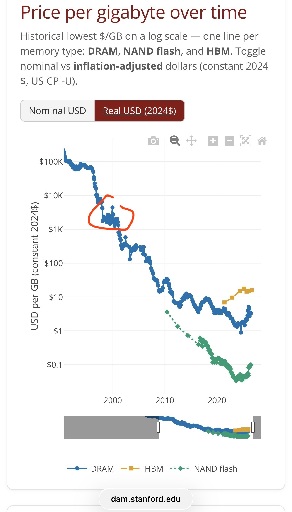
  • They have fixed prices before but that looked different. See the circled area on the graph where there had been declining RAM prices but that decline suddenly stopped and became really stable? That period of 1998-2002 is where Hynix, Infineon, Micron Technology, Samsung, and Elpida were all found to have been fixing prices on RAM because all the supply they were bringing online was crashing the prices but they hoped to collude with each other to keep the prices stable rather than continuing to decline in price competition.

    That coordination worked well for the way down (except when they got hit for hundreds of millions of dollars & euros in fees when it got discovered but eh), just a matter of agreeing on a number they all won’t go below. But how would they coordinate a continuous rise in lockstep with each other, that’s a LOT of phone calls anytime someone wants to buy? Why are many committing the billions of dollars to building new plants if they know that the only reason they’re making money hand over fist is avoiding selling product until it reaches a high price, why shell out money to bring supply up in that case? And why did their previous price fixing look only like a flat line if they were capable of having it go straight up? If they had that ability all along I don’t think you would have seen this somewhat sinusoidal graph with a sharply downward longtime trend for prices.